Networks of Cooperation: Sustainable Structures for Ukrainian Cultural Actors in Europe and Beyond
at /

International Conference from 15–16 October 2026 at Kunsthaus Graz
read more /
Dorottya Szonja Koltay
Artist-in-Residence September–October 2026, Hungary /

read more /
Call for Artist in Residence - MQ residency 2027
Artist-in-Residence Programme at MuseumsQuartier in Vienna / hu /

The Artist in Residence Programme at MuseumsQuartier in Vienna is part of ERSTE Foundation’s long-term endeavour to support contemporary art and to strengthen the fragile situation of its creators, especially in the region of Central, Eastern, and Southeastern Europe.
read more /
Summer School “Ecologies of Emancipation” – 6th Edition: The Golden Age of the Dark Enlightenment?
CALL FOR PARTICIPATION / ro /

10–16 August 2026
Location: hypha_etc, Câmpu Cetății, Mureș County (Romania)
Application deadline closed on 30 June 2026
Rarely has an ideological platform transformed so rapidly from a niche, marginal, and extreme set of public ideas into an objective reality and an uninhibited Zeitgeist. The Dark Enlightenment has accomplished precisely this within barely a decade: from an internet counterculture carrying an explicitly reactionary charge – anti-egalitarian and repressive, obscurantist yet no less technocratic, hierarchical-elitist, and simultaneously populist-demagogic, libertarian and neoliberal while also corporatist-feudal – it has become an assertive and aggressive component of public discourse, both in the centers of the core and in the peripheries and semi-peripheries of the world-system. At the same time, it is also the objective reality of a world surviving beyond its own modern, Enlightenment foundations: on the one hand, the international legal order, now abolished and reconverted into a state of nature through a series of military aggressions conducted under exceptional legal regimes initiated by the world’s hegemonic powers, from the Iraq War to Ukraine, the genocide in Gaza, and the recent war against Iran and Lebanon: on the one hand, the international legal order, now abolished and reverted to a state of nature by a series of military aggressions under exceptional legal regimes initiated by the world’s hegemonies, from the war in Iraq to Ukraine, to the genocide in Gaza and the recent war on Iran and Lebanon; and on the other hand, the welfare-state social compromise of modern states, the package of recognition and redistribution that until recently formed the basis of democratic systems, today deeply eroded by increasingly severe waves of austerity policies and overexploitation, segregation, and exclusion. It seems that the Dark Enlightenment is the most radical and overt theoretical justification for the betrayal of Enlightenment ideals in political practice over the past few decades. The success of this spectacular achievement of the Dark Enlightenment is all the more remarkable in that it did not need to go through the “mass” phase — through the dissemination and adoption of this perspective by the majority of society — but leaped directly from social media channels and the corridors of venture & platform capitalism into the halls and salons of official power and the mainstream media, rebuilding its popularity rather retroactively and from the top down.
This year’s edition of the summer school “Ecologies of Emancipation” seeks to interrogate not only the configuration and spectacular evolution of this ideological platform – both in terms of its ideological content and its material (political-economic) foundations – but also, more broadly and more urgently, the kind of world in which such an ideology, grounded in such a material basis, could become a general metanarrative overnight.Thus, alongside the ideological background of the Dark Enlightenment and its reverberations on the left in various forms of accelerationism, the presentations delivered within the summer school will examine the current crisis of the international legal order and modern constitutionalism, civilizational legitimations, the reactionary echoes of neoliberal thought as well as of new labor and production relations, the cultural and educational policies of the new reaction, the alliance between venture and platform capitalism and the military complex as the material basis of the post-liberal order, as well as the crises, challenges, and possibilities for the reconstitution of emancipatory movements in this context.
This year’s edition of the “Ecologies of Emancipation” summer school aims to examine not only the structure and spectacular evolution of this ideological platform—that is, both its ideological content and its material (political-economic) foundation—but also, more broadly and with greater concern, what kind of world this is in which such an ideology, with such a material basis, could become a general metanarrative overnight. Thus, in addition to the ideological underpinnings of the Dark Enlightenment, as well as its reverberations on the left in various forms of accelerationism, the presentations delivered at the school will examine the current crisis of the international legal order and modern constitutionalism, civilizational legitimations, the reactionary echoes of neoliberal thought as well as of new relations of labor and production, the cultural and educational policies of the new reaction, the alliance between venture & platform capitalism and the military-industrial complex as the material basis of the post-liberal order, as well as the crises, challenges, and opportunities for the reconstitution of emancipation movements in this context.
read more /
The Artist-in-Residence Programme at MQ21/MuseumsQuartier in Vienna 2027
CALL FOR APPLICATIONS open until September 15th, 2026 / ro /

The Artist in Residence Programme at MuseumsQuartier in Vienna is part of ERSTE Foundation’s long-term endeavour to support contemporary art and to strengthen the fragile situation of its creators, especially in the region of Central, Eastern, and Southeastern Europe.
The residency programme is carried out in close cooperation with ERSTE Foundation's key cultural partners: tranzit.org, Igor Zabel Association, and Kontakt Collection (Kontakt Collection will collaborate with the Zagreb based WHW Akademija.) Thus, the residencies are aimed at artists and curators from Croatia, Czech Republic, Hungary, Romania, Slovak Republic, and Slovenia working in the field of critical contemporary visual art to do research in their respective area.
Taking into consideration the urgencies raised by the ongoing war against Ukraine, we would like to express our solidarity and add a grant of a two-month stay for a participant from Ukraine.
The research character of the residency should make it possible to take a break from strenuous situations, from everyday production pressure, and find time to concentrate on a specific interest. The participants are given the opportunity to live and work in one of the MuseumsQuartier studios right in the heart of Vienna. The apartments offer both living and working space, but do not provide room for large-scale artistic works.
Please note: pets are not permitted at the residency.
During the stay various meeting possibilities are offered to the participants.
Each residency grants a monthly stipend of EUR 1.300,– plus a one-time travel grant of EUR 300,– (non-EU: EUR 500,–).
Together with its cooperation partners from tranzit.at, tranzit.cz, tranzit.hu, tranzit.ro, tranzit.sk, Igor Zabel Association and Kontakt Collection/WHW Akademija, ERSTE Foundation forms the jury to select the participants.
read more /
Subscribe to the curated newsletter of tranzit.org
hu /
The tranzit.org network is developing many new collaborative projects. Subscribe to our newsletter for updates on major international events, collaborations, and more. Every month, we'll send you a concise overview of upcoming projects and documentation for those that have already taken place.
read more /
The summer school DIAGRAMS OF WATER
ro /

Alternator, the interdisciplinary working platform developed around topics related to the Danube–Black Sea Canal and waterborne transport infrastructures both globally and in the South-East Europe region, in partnership with tranzit.ro/București organises
The summer school DIAGRAMS OF WATER, in the period 27—31 July. The workshops, presentations, and film screenings will be split between the Experimental Research Station for Art and Life and 24 Arcului Street.
The summer school offers an interdisciplinary program dedicated to exploring water as a biological, ecological, and social matter, viewed through the infrastructures that make it possible, distribute it, and control it. In the context of the climate crisis and geopolitical changes, water is becoming increasingly visible not only as a resource, but also as a space of tension, negotiation, and imagination. From pipelines and dams to bodies and ecosystems, from access and distribution to crisis and resistance, the Diagrams of Water summer school proposes an investigation of water as both material and imagined infrastructure.
The Summer School programme adopts an interdisciplinary approach, bringing together artists, theorists, and practitioners from a range of fields. Over the course of one week, participants will explore topics through a series of workshops, including water at the intersection of theory and literature, the ethics of artists' moving image, monumental art, illustration, and curatorial approaches related to the programme's theme. The workshop series concludes with a session dedicated to practices of political and food autonomy.
read more /
FUTURE GARDENING
by Onkruidenier (Amsterdam) / ro /

Saturday, 25 July
15:00 – 19:00
The Experimental Station for Research on Art and Life
Intr. Primăverii 10, Siliștea Snagovului
GPS coordinates
De Onkruidenier is a Dutch artist collective exploring the evolving relationship between humans and ecosystems through artistic research, installations, performances, and sensory experiences. Their current artistic research investigates how genetic biodiversity is shaped, displaced, preserved, and reimagined through agriculture, food cultures, and ecological change.
Future Gardening is an ongoing artistic practice by De Onkruidenier that explores gardening as a multisensory method for engaging with ecological futures. Rather than cultivating a garden, we cultivate ways of observing and attuning ourselves to the ecosystems we inhabit.
Through collective observation, participants are invited to reflect on their own role within the ecosystem and to explore how gardening can become a practice for engaging with questions of genetic biodiversity. By working with soil, geology, wild plants and seasonal rhythms, we investigate how ecological relationships are cultivated.
At the Experimental Station, Future Gardening focuses on the ecological memory embedded in wild plants and the local geology, exploring how these living archives relate to contemporary food systems. Together, we will search for stories, species, and relationships that become part of the installation On the Same Ribbon at MODEM in Debrecen.
What can wild plants teach us about the future of food? Where is genetic diversity preserved today? Has the supermarket become an unexpected archive of genetic biodiversity?
read more /
SOIL MICROBIOLOGY: SCIENCE BENEATH THE SURFACE
Georgiana Grigore & Emilia Tănase (Bucharest) / ro /
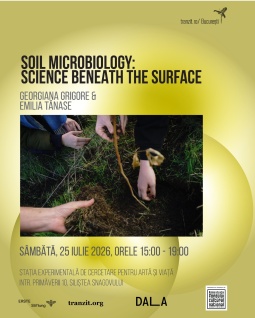
Saturday, 25 July
15:00 – 19:00
The Experimental Station for Research on Art and Life
Intr. Primăverii 10, Siliștea Snagovului
GPS coordinates
The session will begin with a brief introduction to soil microorganisms, highlighting their essential role in maintaining soil health and supporting ecosystem functioning. The presenters will explain the benefits these microorganisms provide to plants and the environment, while also discussing the other side of the topic by introducing pathogenic microorganisms that can cause diseases in various plant species.
The second part of the workshop will consist of a hands-on practical activity. Participants will have the opportunity to observe bacteria and microscopic fungi (molds) under the microscope using slides prepared during the workshop. The presenters will also bring cultures of microorganisms isolated from soil to demonstrate how these organisms are studied in the laboratory. This activity will allow participants to explore microorganisms that are invisible to the naked eye and gain insight into the techniques used to investigate them.
Partner: DALA Foundation
read more /
Subscribe to the curated newsletter of tranzit.org
cz /
The tranzit.org network is developing many new collaborative projects. Subscribe to our newsletter for updates on major international events, collaborations, and more. Every month, we'll send you a concise overview of upcoming projects and documentation for those that have already taken place.
read more /
Emigrant Melodies: Leaf Whistling
Kitti Gosztola and Bence György Pálinkás / ro /

Saturday, 18 July
15:00 – 19:00
The Experimental Station for Research on Art and Life
Intr. Primăverii 10, Siliștea Snagovului
GPS CoordInates
For their workshop at the Experimental Station, Kitti Gosztola and Bence György Pálinkás will explore the traditional folk technique of leaf whistling together with the participants.
Gosztola and Pálinkás have long been interested in the role and symbol of plants in folk culture and folk music. Culture, often perceived as national, is shaped by a constant exchange of its building blocks. Melodies and lyrics travel across linguistic and cultural borders. Plants also move with humans. The artists’ projects try to look at culture not as something that needs to be conserved in an imagined pure form, but as something that needs to be in constant motion.
The leaf whistle can only sound while the plant still holds enough moisture and flexibility, so the sound remains ephemeral and closely tied to the living material. They will experiment with the different sounds of different so-called native and alien species. And they will try to sound together with this archaic technique which is especially good for expressing feelings.
read more /
Romania's Ways of Opening to the World: A Conversation with Bogdan Iacob
ro /
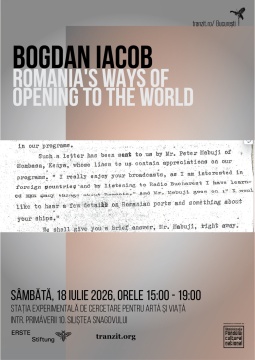
Saturday, 18 July
15:00 – 19:00
The Experimental Station for Research on Art and Life
Intr. Primăverii 10, Siliștea Snagovului
GPS CoordInates
The former socialist states of the Eastern Bloc have the distinct and rare epistemic advantage of going in recent history through the living experience of two very different paradigms that have determined to a significant extent both the internal social order and the external political positioning and presence. However, the width of this epistemic difference has been all but erased in the exclusively Western orientation of East European working bodies and minds after the “opening” of the Iron Curtain, which ironically has reduced the local sense of the world. But how did the travelers, the workers and the professional classes – doctors, architects, artists – traverse this difference, then and now? What lessons could be learned and what remains valid and useful for reopening our sense of the world today, towards a world of solidarity and plurality, hope and reinvention?
Coordinated by Ovidiu Tichindeleanu, the conversations in Living Thought aim to introduce contemporary scholars and artists who are working in the emerging field of knowledge and practices relating to land, to indigenous/ancestral knowledges and eco-social realities, and who are proposing not only reviews of problems, but visionary alternative paths. Continuing of the ongoing work of the Experimental Station for Research on Art and Life, the intellectual conversations in Living Thought are tools of conviviality aiming to spark the radical imagination needed to change our relations to culture, to re-orient our sense of the world, and to regain an ethical life outside the ongoing war on life.
read more /
CALL for APPLICATIONS 2027 now open until September 15, 2026
The residencies are aimed at artists and curators from Croatia, Czech Republic, Hungary, Romania, Slovak Republic, and Slovenia working in the field of critical contemporary visual art to do research in their respective area.
Taking into consideration the urgencies raised by the ongoing war against Ukraine, we would like to express our solidarity and add a grant of a two-month stay for a participant from Ukraine.
read more /
ongoing/
Summer School “Ecologies of Emancipation” – 6th Edition: The Golden Age of the Dark Enlightenment?
CALL FOR PARTICIPATION / ro /
read more /
Biennale Matter of Art 2026
49 artists and collectives, and dozens of events across three venues in Prague and Pardubice / cz /
read more /
Call for Artist in Residence - MQ residency 2027
Artist-in-Residence Programme at MuseumsQuartier in Vienna / hu /
read more /
The Artist-in-Residence Programme at MQ21/MuseumsQuartier in Vienna 2027
CALL FOR APPLICATIONS open until September 15th, 2026 / ro /
read more /
Imagined Organisations: Practices of Artistic Research Moving Across Semiperipheries
Biennale Matter of Art
The project comprises the international exhibition of contemporary art taking place once every two years as well as the platform’s long-term activities, which engage in critical reflection of the institutional aspects of the biennale format in the / cz /
read more /
The Space of Opportunity is open
Community space under 63 Práter Street / hu /
read more /
Revolting with Care
Research, publishing, workshops, discussion forums / sk /
read more /
ERSTE Foundation is the main partner of tranzit:
